
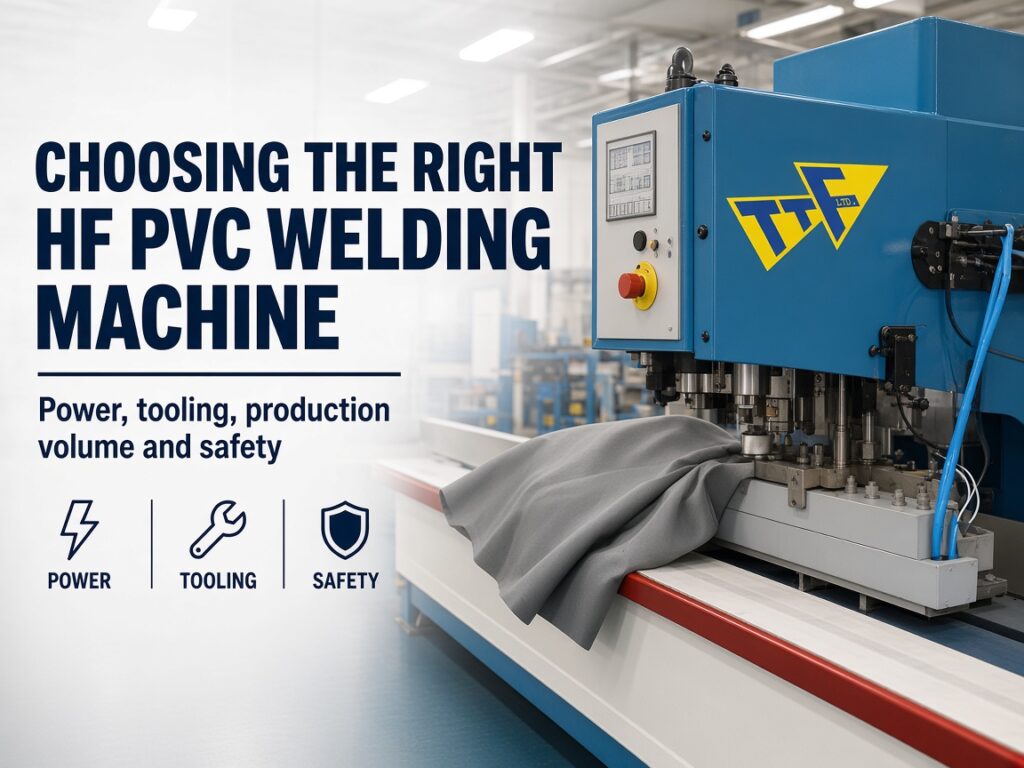
If you manufacture PVC products, choosing the right welding machine can make a real difference to the quality and consistency of your finished products. But with different machine sizes, power ratings and tooling options available, how do you know which HF PVC welding machine is right for your business?
What is an HF PVC welding machine?
An HF PVC welding machine uses high-frequency electromagnetic energy to generate heat within suitable PVC materials. Pressure brings the softened layers together, and the material cools under pressure to form the finished weld. This process is commonly used to manufacture products such as:
- Waterproof bags and covers
- PVC tarpaulins
- Inflatable products
- Flexible plastic components
- Technical textiles
- Certain medical products
- PVC-coated fabric accessories
The main advantage is that the machine can produce consistent, sealed joints when the material, tooling and welding settings are correctly matched.
Consider the type of PVC you use
Before looking at machine specifications, check the material you intend to weld. PVC is available in different formulations, thicknesses and constructions. Flexible PVC film, for example, may require different settings from thicker or more rigid PVC material. If you are working with PVC-coated textiles, the coating itself is particularly important because it forms the welded joint.
Ask your material supplier whether the PVC is suitable for HF welding. If you plan to process several different materials, test samples before selecting your machine.
This simple step can help prevent you from purchasing equipment that is unsuitable for your production requirements.
Choose the correct machine power
Machine power is one of the main considerations when choosing an HF PVC welding machine. The required power depends on several factors, including the size and shape of the weld, material thickness, electrode design and the cycle time you need to achieve.
For example, a machine designed for small bags or labels may not be suitable for welding large tarpaulins or wide PVC panels. However, choosing the machine with the highest power rating is not automatically the best decision. Excessive or poorly controlled energy can damage the material, while insufficient power may result in incomplete welding.
The best approach is to provide your machine supplier with the material specifications, product dimensions and proposed weld design so that the required power can be assessed properly.
Think about your product size
The size of your finished product should influence the machine configuration you choose.
If you manufacture small PVC components, a compact machine with a suitable working area may be sufficient. However, larger products, such as industrial covers or wide coated-fabric panels, may require a larger table, greater working clearance or specialist machine arrangements.
Remember to consider the position of the weld as well as the overall product dimensions. You need enough space to position the material accurately and move it safely through the welding operation.
Select suitable electrodes and tooling
The electrode is the tool that determines the shape and position of the weld. Different products require different electrode designs. For example, a simple straight seam may need straightforward tooling, while a product with curved edges, attachment points or complicated outlines may require a custom electrode. This means that before purchasing a machine, you will need to establish whether the supplier can provide tooling for your specific product. You should also consider how easily electrodes can be changed when switching between product designs. If your business manufactures several different PVC products, quick and straightforward changeovers can make production more flexible.
Match the machine to your production volume
How many products do you manufacture each day or week? For smaller production runs, a manually operated machine may offer sufficient capacity and flexibility. For medium-volume production, a machine with a more automated pressing cycle or improved material positioning may help maintain consistency. High-volume manufacturing may benefit from semi-automatic or fully automatic equipment, depending on the product and production process.
The important thing is to choose a machine that meets your actual output requirements without paying for automation you do not need.
Check the quality and consistency of the weld
A good HF PVC welding machine should help you produce repeatable welds when operated correctly. Look at the available controls for welding time, power, pressure and cooling. The level of adjustment and monitoring you need will depend on your materials and products.
If you manufacture waterproof or airtight products, you should also ask whether the proposed machine can produce the required seam quality and whether the supplier can demonstrate this using your material.
A weld that looks good is not necessarily airtight or strong enough for its intended use, so suitable performance testing is important.
Consider operator safety and maintenance
Safety should be part of your purchasing decision from the beginning. HF welding machines operate using high-frequency electrical energy and can involve high voltages and moving press mechanisms. Look for appropriate guarding, interlocks, emergency stops and protection against electrical arcing. The machine should be installed, maintained and operated in accordance with the manufacturer’s instructions and applicable safety requirements.
You should also check the availability of spare parts, technical support and maintenance services. A machine that is difficult to service can create unnecessary downtime.
So, how do you choose the right HF PVC welding machine?
Choosing the right machine starts with understanding your material and the products you need to manufacture. Consider the PVC formulation, material thickness, weld dimensions, required output, tooling, automation and safety features before comparing machine models.
For manufacturers working with PVC-coated textiles, bags, covers and flexible plastic products, HF welding can be an effective way to produce strong and consistent seams.
The best HF PVC welding machine is the one that matches your material, product design and production needs. By testing your materials and discussing your requirements with a knowledgeable supplier, you can make a more informed investment and build a reliable welding process for your business.