
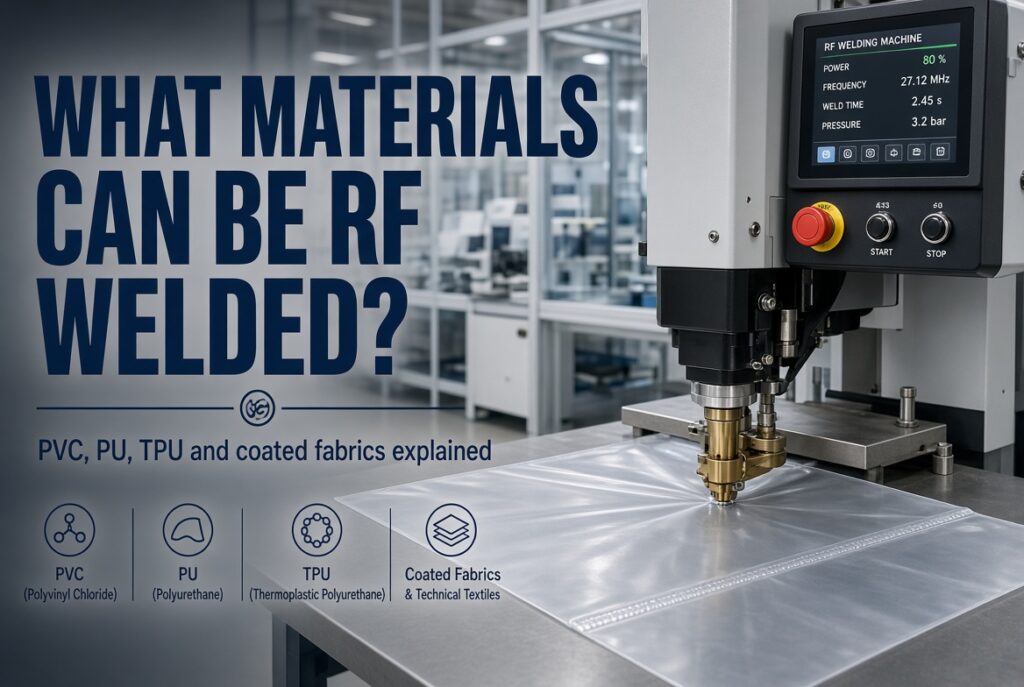
Radio-frequency (RF) welding, also known as high-frequency (HF) welding, is a specialist process used to join certain thermoplastic materials. It can create strong, consistent and sealed seams, making it particularly useful for products that need to be airtight or watertight. However, RF welding does not work with every type of plastic. The material needs to have the right properties to respond to the electromagnetic energy used during the welding process. So, what materials can be RF welded, and which plastics are most commonly used?
What is RF welding?
RF welding uses high-frequency electromagnetic energy to generate heat within a compatible material. The materials are positioned between specialist electrodes or tooling. When the RF energy is applied, the molecules within the material respond to the electromagnetic field and generate heat.
The material softens at the intended weld area, allowing pressure to be applied. Once the RF energy is removed, the material cools while under pressure, creating a permanent welded seam.
Because the heat is generated within the material rather than simply being applied to the outside surface, RF welding can produce precise and consistent welds.
You can read a useful overview of the process on Wikipedia’s radio-frequency welding page and this practical explainer on what high frequency welding is.
Here at TTF Ltd, we specialise in high frequency, ultrasonic and heat welding equipment for sealing flexible plastics.
What materials can be RF welded?
RF welding is generally suitable for thermoplastic materials with suitable electrical properties. The most commonly RF-welded materials include:
- PVC
- PU (polyurethane)
- TPU (thermoplastic polyurethane)
- Certain thermoplastic-coated fabrics
- Some other polar thermoplastics
PVC is one of the most widely used materials for RF welding, particularly flexible PVC.
However, the exact formulation of a material can affect its suitability. For example, two products that appear to be made from the same type of plastic may respond differently depending on additives, plasticisers, coatings and other components. For this reason, you should always establish whether the specific material is suitable for RF welding rather than relying solely on its general material classification.
Can PVC be RF welded?
Yes. PVC is one of the most commonly RF-welded plastics.
Flexible PVC is particularly well suited to the process because it can respond effectively to the high-frequency electromagnetic field and form a strong welded seam. RF welding PVC can be used to manufacture products such as:
- Inflatable products
- PVC covers
- Flexible containers
- Protective covers
- Tarpaulins
- Industrial curtains
- Flexible tanks
- Bags and pouches
- Technical textile products
The process can produce airtight and watertight seams, making it useful for products that need to contain air or liquids.
Can polyurethane be RF welded?
Certain polyurethane (PU) materials can also be RF welded. Polyurethane is used in a wide range of flexible and technical products, and suitable formulations can respond well to RF energy.
As with PVC, the precise formulation of the polyurethane is important. Different grades and constructions can have different welding characteristics.
If you are considering RF welding a polyurethane product, testing the material with the proposed tooling and welding parameters can help establish whether it is suitable.
Can TPU be RF welded?
Thermoplastic polyurethane (TPU) can be suitable for RF welding, depending on its formulation and construction.
TPU combines flexibility with useful mechanical properties, which makes it attractive for certain technical and industrial applications.
Where the material is compatible with RF welding, the process can be used to create strong seams without requiring conventional adhesives.
However, TPU is available in many different grades, so you should confirm the specific material’s RF welding characteristics before beginning production.
Can coated fabrics be RF welded?
Yes, some coated fabrics can be RF welded where the coating contains a suitable thermoplastic material. This can be particularly useful when manufacturing flexible products that combine a fabric reinforcement with a weldable plastic coating.
The RF energy interacts with the compatible coating rather than necessarily welding the fabric itself. Examples can include certain PVC-coated or thermoplastic-coated fabrics used in industrial and technical applications.
The composition and thickness of the coating will affect how the material responds to RF energy, so the exact construction needs to be considered.
Can polyethylene be RF welded?
Standard polyethylene is generally not considered a suitable material for conventional RF welding. This is because polyethylene does not respond to RF energy in the same way as materials such as PVC, meaning it is generally better suited to other joining techniques.
Depending on the application, polyethylene may instead be joined using methods such as hot-air welding, hot-plate welding or other thermal processes.
If you are working with a material that contains polyethylene alongside another plastic, the overall construction will need to be assessed before selecting an RF welding process.
Can polypropylene be RF welded?
Like polyethylene, polypropylene is generally not well suited to conventional RF welding, as it does not have the same dielectric properties that make materials such as PVC particularly responsive to RF energy.
Other welding methods can be more appropriate for polypropylene, including hot-plate, ultrasonic or other thermal welding techniques depending on the product.
Choosing the correct process is therefore important when working with plastics that cannot be efficiently heated using RF energy.
Why does the material matter in RF welding?
The material’s electrical properties are one of the most important factors in determining whether RF welding will work. This is because RF welding relies on electromagnetic energy interacting with the material and generating heat. As a result, materials with suitable dielectric properties that can absorb this energy and heat sufficiently are suitable for welding. In contrast, materials that do not respond effectively will not generate enough heat at the joint, making it difficult or impossible to create a reliable weld.
A helpful industry overview of RF welding for PVC and PU is available from Forsstrom.
Does material thickness affect RF welding?
Yes. Material thickness can affect how a material responds to RF energy and how the finished weld performs. Thicker materials, for example, may require different welding parameters from thinner materials. The construction of the product can also affect how energy is distributed through the weld area. As a result, you may need to adjust factors such as:
- RF power
- Welding time
- Pressure
- Cooling time
- Electrode design
- Weld width
The correct settings will depend on the particular material and product. Our engineering service team can help with technical support, training and machine set-up.
Does the formulation of the plastic matter?
Yes. The exact formulation can be just as important as the basic material type.
PVC, polyurethane and TPU are available in many different grades and formulations. Manufacturers may add plasticisers, stabilisers, fillers, coatings or other additives to achieve particular properties. All of these changes can affect how the material responds to RF energy and how strong the finished weld will be.
For this reason, you should test the actual material you intend to use rather than assuming that a previous RF welding process will work with a different grade of the same plastic.
What products are made using RF welding?
RF welding is particularly useful for products that require strong, sealed and repeatable seams. Depending on the material, RF welding can be used to manufacture:
- Inflatable structures
- Medical and healthcare products
- Flexible tanks
- PVC covers
- Protective products
- Industrial curtains
- Bags and pouches
- Tarpaulins
- Flexible ducts
- Technical textile products
The process can also be used to create straight, curved, angled and complex weld patterns when suitable tooling is designed for the product. You can find out more about the industries we work with.
So, what materials can be RF welded?
RF welding is most commonly associated with thermoplastic materials that have suitable electrical properties, with PVC being one of the most widely used. Suitable grades of polyurethane and TPU can also be RF welded, while certain thermoplastic-coated fabrics may be suitable where the coating is compatible with the process.
However, not every plastic can be RF welded. Materials such as conventional polyethylene and polypropylene are generally better suited to other welding techniques, while conventional rubber is typically unsuitable for RF welding.
The exact formulation, thickness and construction of the material all need to be considered. By testing the specific material and choosing the correct tooling and welding parameters, you can determine whether RF welding is suitable for your application.
Here at TTF, we are leading specialists in high frequency, ultrasonic and heat welding equipment for sealing flexible plastics. So for more information or advice, why not get in touch today?