
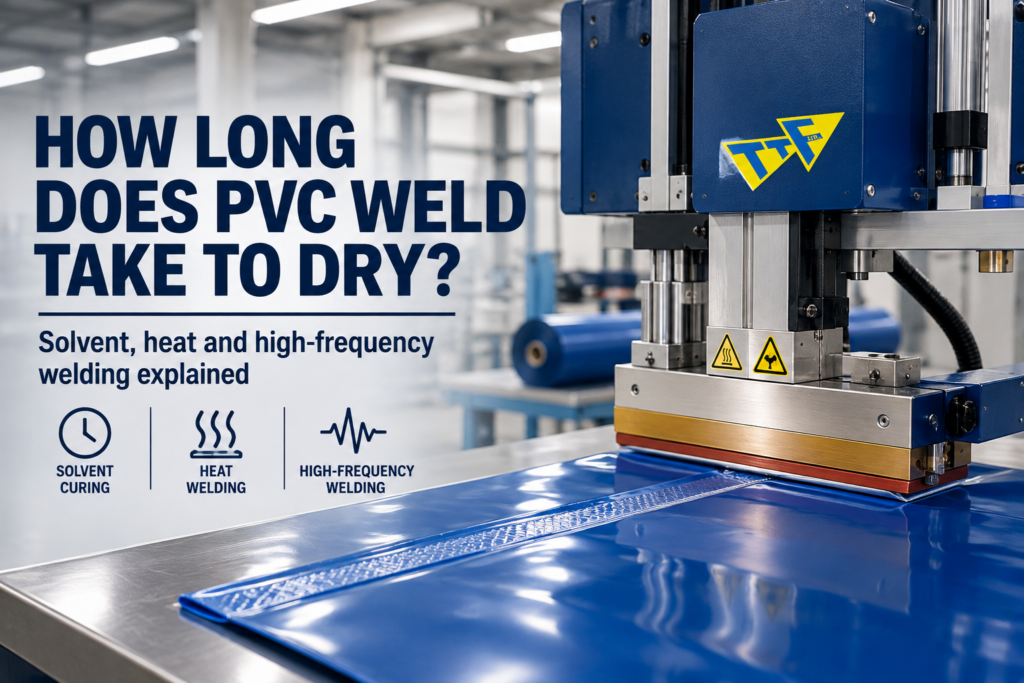
If you have just joined two pieces of PVC, you may be wondering how long you need to wait before the joint is ready to use. The answer depends on what type of PVC welding you are doing. This is because PVC can be joined using several different methods. Solvent welding uses a PVC cement that needs time to cure, while heat welding and High Frequency (HF) welding work differently and do not need to “dry” in the same way. So, how long does a PVC weld take to dry?
Does a PVC weld need to dry?
Not every PVC weld needs to dry. If you are using PVC solvent cement, the joint needs time for the solvents to evaporate and the joint to develop its strength. This is normally referred to as curing rather than simply drying.
With thermal or HF welding, there is no liquid adhesive that needs to dry. Instead, the PVC is heated, fused and then allowed to cool.
This distinction is important if you are working with PVC products in different parts of the manufacturing industry.
How long does PVC solvent weld take to cure?
There is no single curing time that applies to every PVC solvent-welded joint as the required time can depend on:
- The type of PVC cement
- Pipe or material size
- Temperature
- Humidity
- Joint design
- Material thickness
- Pressure the joint will experience
- The manufacturer’s instructions
As a general guide, some PVC solvent-cement joints can reach useful handling strength relatively quickly, but they may need several hours before being put under pressure. Larger joints and less favourable conditions can require considerably longer.
For this reason, you should always follow the curing instructions supplied with the particular PVC cement rather than relying on a general time.
What is the difference between drying and curing?
Drying usually refers to a liquid losing moisture or solvent from its surface. Curing refers to the joint developing its required properties over time.
A PVC solvent-welded joint may look dry on the outside before it has reached its full working strength. This means that touching the joint and deciding that it “feels dry” is not a reliable way of deciding whether it is ready for use.
How long does HF welded PVC take to cool?
With HF welding, suitable PVC material is heated using high-frequency electromagnetic energy. Pressure is applied to the material and the weld is then allowed to cool under controlled conditions. There is therefore no traditional drying period.
The welding cycle itself can be relatively short, with the exact time depending on the material, thickness, machine settings, tooling and product design. Once the weld has completed its cycle and cooled sufficiently, the product can generally move on to the next manufacturing stage.
This is one reason HF welding can be useful for production environments where repeatable PVC seams are required.
TTF specialises in High Frequency PVC sealing equipment and supplies both new HF welding machines and a range of refurbished HF welding machines for different manufacturing requirements.
What affects PVC weld time?
There are several factors that can change how long the overall process takes. These include:
- Material thickness: Thicker PVC can require different welding conditions from thin film or coated textile.
- Welding method: A solvent-welded pipe joint has a very different curing process from an HF-welded PVC bag or coated fabric.
- Temperature: Cold conditions can affect solvent evaporation and the curing process. They can also affect how welding equipment needs to be set up.
- Product design: A simple straight seam may be much easier to process than a product containing corners, curves, multiple layers or complicated shapes.
- Machine settings: With HF welding, power, pressure, welding time and cooling conditions all contribute to the final result.
Tooling can also play an important role in the welding process. TTF supplies HF welding tooling, parts and consumables, with tooling designed around the requirements of the particular product being manufactured.
Can you use PVC immediately after welding?
You should not assume that every PVC weld can be used immediately. For solvent welding, the joint needs to reach the recommended cure before being subjected to its intended service conditions. For HF welding, the finished weld needs to complete the appropriate welding and cooling cycle.
The safest approach is therefore to follow the instructions for the particular material, machine or welding product rather than using a fixed “wait X minutes” rule.
Why is this important in textile manufacturing?
The question becomes particularly relevant when PVC is being used in flexible products and coated textiles, where PVC-coated fabrics may be welded to create sealed seams for products such as:
- Waterproof covers
- Tarpaulins
- Bags
- Inflatable products
- Protective covers
- Technical textiles
In these applications, HF welding can produce the finished seam as part of a controlled machine cycle rather than requiring an adhesive to dry. This can be useful when you are manufacturing repeated products and need predictable production times.
For example, TTF supplies HF welding equipment for manufacturing applications including tarpaulins, medical products, automotive components, safety products and packaging.
How do you know when a PVC weld is ready?
The answer depends on the welding method.
For solvent welding, follow the manufacturer’s curing instructions and consider the conditions in which the joint was made.
For HF welding, the machine cycle, material requirements and cooling stage determine when the weld is ready.
Where the seam is important to the performance of the finished product, testing is also valuable. A weld may look acceptable but still fail if the materials have not bonded correctly.
Getting consistent results with HF welding
For manufacturers using HF welding, achieving repeatable results depends on the correct combination of material, tooling, machine settings and operator knowledge.
TTF offers HF welding training covering everything from operating HF welding equipment to a more in-depth understanding of the machinery. Training can also be tailored around particular product applications.
Existing machinery also needs to be correctly maintained and configured. TTF provides HF welding machine servicing and technical support, including annual servicing, breakdown assistance, machine installation and technical support.
So, how long does a PVC weld take to dry?
There isn’t one universal drying time for a PVC weld.
A solvent-welded PVC joint needs time to cure, and the required period can range from relatively short handling times to several hours or longer depending on the application and conditions.
An HF-welded PVC seam is different. It does not need to dry because there is no solvent cement involved. Instead, the PVC is heated, fused and cooled as part of the welding cycle.
If you manufacture products using PVC films, sheets or coated textiles, TTF Ltd supplies HF welding machinery alongside tooling, parts, servicing, technical support and operator training.