
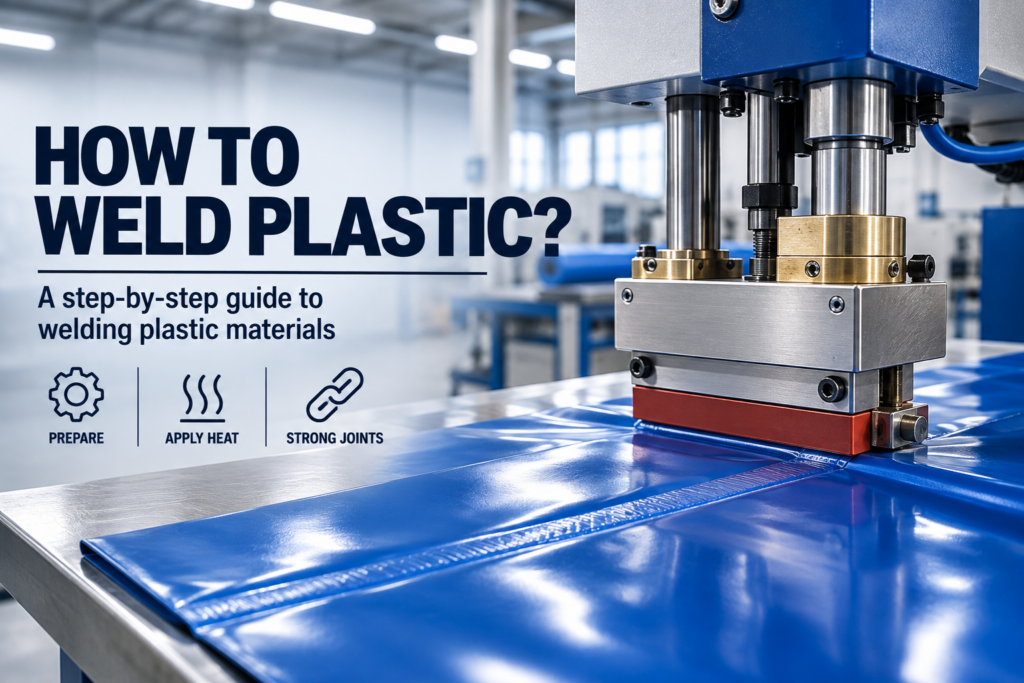
If you need to join two pieces of plastic together, welding can be an effective alternative to screws, adhesives or other joining methods. But how do you actually weld plastic, and which method should you use?
What is plastic welding?
Plastic welding involves heating compatible thermoplastic materials until they become soft enough to fuse together. Once the material cools, the two pieces form a permanent joint.
There are several ways to weld plastic, including hot-air welding, hot-plate welding, ultrasonic welding and High Frequency (HF) welding. The best method depends on the type of plastic, the shape of the product and the type of joint you need to create.
For further technical information about the different processes available, see TWI’s guide to polymer welding.
What plastics can be welded?
Not all plastics can be welded using the same process. Thermoplastics are generally the most suitable because they can be softened with heat and then solidify again as they cool. As such, common plastics used in welding applications include:
- PVC
- Polyurethane (PU)
- TPU
- EVA
- Some PET materials
- Certain other thermoplastics
For HF welding in particular, PVC and PU are among the most common materials. TWI provides further information about which thermoplastic materials can be RF welded.
How do you weld plastic?
The basic process is relatively straightforward, although the equipment and settings vary depending on the welding method.
1. Identify the material
Before starting, check exactly what type of plastic you are working with. You need to know whether it is compatible with your chosen welding process.
If you are working with coated fabric, you should also establish what the coating is made from. The coating may be the part of the material that actually forms the weld.
2. Prepare the surfaces
The surfaces being joined should be clean and correctly positioned. This is because dirt, moisture, contamination or incorrect alignment can affect the quality of the finished weld.
For production work, it is also important to make sure the material is presented in the same position for each weld.
3. Apply the correct welding process
The welding machine applies energy to the joining area. With hot-air welding, heat is directed onto the material from an external source. With HF welding, a high-frequency electromagnetic field generates heat within suitable plastic materials. Pressure is then applied through the tooling while the material cools.
TTF supplies a range of new welding machines, including HF welding machines for applications such as tarpaulins, medical products, automotive components, safety products and packaging.
4. Allow the weld to set
The material needs to cool sufficiently for the joint to become stable. With HF welding, the material is held under pressure during cooling. This helps the welded layers form a consistent joint. The finished result should also be checked to make sure the weld has bonded correctly.
How do you HF weld plastic?
HF welding is particularly useful for suitable plastic films, sheets and coated textiles. The process normally involves placing the materials between an electrode and a supporting surface. The machine then applies a high-frequency electromagnetic field.
The energy causes suitable molecules within the material to generate heat. As the material softens, pressure brings the layers together. The pressure is maintained as the material cools, producing the finished weld.
The TWI High Frequency Welding Handbook provides more detailed technical information about how the HF welding process works.
HF welding can be completed in relatively short cycles, which makes it useful for repeat production.
For businesses looking to introduce or upgrade HF welding equipment, TTF supplies both new HF welding machines and a range of refurbished HF welding machines.
What is HF welding used for?
HF welding can be used to join PVC, PU and other suitable thermoplastic materials, and some typical applications include:
- PVC-coated fabrics
- Waterproof products
- Inflatable products
- Tarpaulins
- Covers
- Bags
- Flexible plastic components
- Medical products
- Technical textiles
- Plastic fittings and attachment points
HF welding machinery is used across a wide range of industries. TTF supplies and services equipment used in sectors including medical, packaging, automotive, tensile structures, banner finishing, inflatables and tarpaulin manufacturing.
How do you get a strong plastic weld?
A strong weld depends on more than simply applying heat, as you will also need to consider:
- The compatibility of the materials
- Material thickness
- Welding temperature or energy
- Welding time
- Pressure
- Cooling time
- Tooling
- Surface condition
- Correct alignment
Using too little energy may result in an incomplete weld, while excessive energy can damage or distort the material. This is why welding parameters should be developed and tested for the particular material and product rather than assuming that one setting will work for everything.
Tooling can also be an important part of producing an effective and repeatable weld. TTF supplies HF welding tooling, parts and consumables, including tooling designed for specific product requirements.
How do you know if a plastic weld is good?
A visual inspection is a useful starting point to check the quality of the weld. You should look for a consistent weld without obvious gaps, burning, excessive distortion or areas that have failed to bond. However, visual inspection alone may not be enough for products where the seam needs to withstand pressure or remain watertight.
Depending on the application, manufacturers may carry out peel, pull, leak or other performance tests to check the finished weld.
Getting the right HF welding setup
Producing consistent HF welds depends on having the appropriate machinery, tooling and operating parameters for the materials and products being manufactured.
TTF offers HF welding training covering equipment operation and more in-depth understanding of HF machinery, with training packages that can be tailored around specific product applications.
For existing machinery, TTF also provides HF welding machine servicing and technical support, including servicing, breakdown assistance, machine installation, technical support and operator training.
So, how do you weld plastic?
To weld plastic successfully, you first need to identify the material and select a welding process that is compatible with it.
For suitable thermoplastics, you then prepare and position the materials, apply the correct amount of heat or electromagnetic energy, use pressure where required and allow the joint to cool and set.
For PVC, PU and suitable coated textiles, HF welding can be an effective way to produce strong, repeatable and sealed joints.
If you are considering HF welding machinery for a manufacturing application, TTF Ltd supplies new and refurbished HF welding machines alongside tooling, consumables, servicing, technical support and training.