
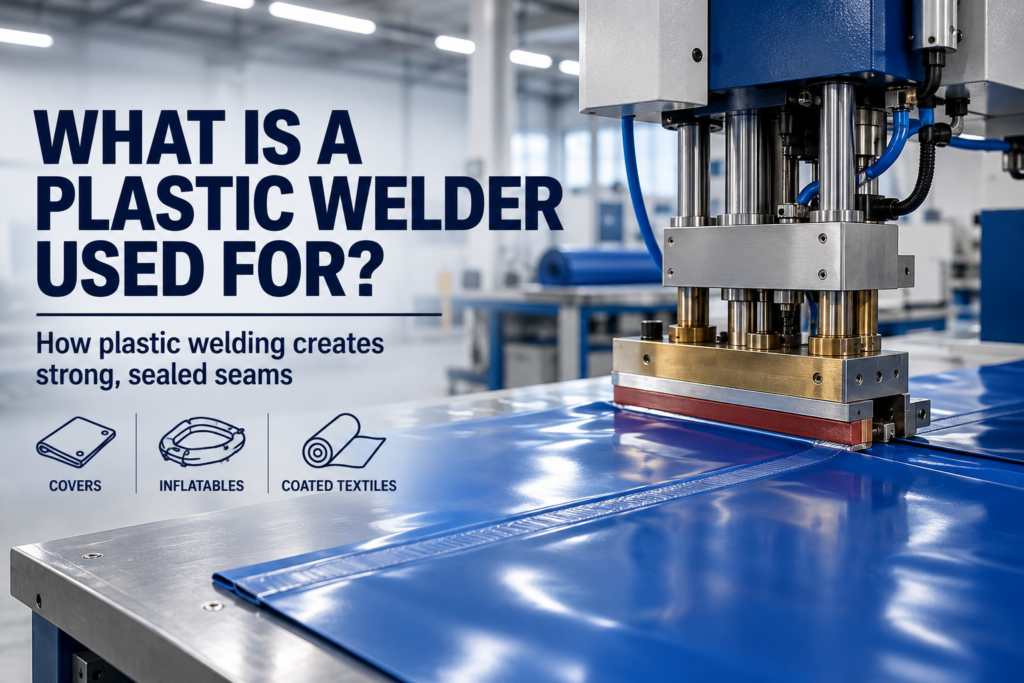
If you work with plastic products, flexible materials or coated textiles, you may come across a plastic welder being used to join materials together. But what exactly is a plastic welder used for, and why would you choose welding instead of sewing, adhesive or another joining method?
What does a plastic welder do?
A plastic welder is used to join compatible thermoplastic materials by creating a permanent bond between them. Depending on the type of welder and the material being joined, the process can be used for everything from repairing plastic components to manufacturing waterproof covers, bags, inflatable products and specialist textile items.
This joining is achieved by softening or melting the material at the joining point and then allowing it to fuse together.
The exact process depends on the type of plastic welding machine being used. For example, a hot-air plastic welder applies heat from an external source, while an HF welder generates heat within suitable plastic materials using a high-frequency electromagnetic field. As a result, the term “plastic welder” can describe a range of different machines rather than one specific type of equipment.
What is a plastic welder used for?
Plastic welders are used wherever thermoplastic materials need to be joined securely. Some of the most common applications include:
- Plastic repairs
- PVC and PU products
- Waterproof covers
- Tarpaulins
- Bags and cases
- Inflatable products
- Medical and protective products
- Automotive plastic components
- Flexible plastic sheets and films
- Coated textile products
- Industrial covers and membranes
- Packaging and specialist plastic products
At TTF, new HF welding machines are supplied for applications across industries including medical, automotive, safety, stationery, packaging and tarpaulin manufacturing.
Can a plastic welder be used for textiles?
Yes. Plastic welding can be particularly useful in textile manufacturing when the fabric contains a thermoplastic coating or film. For example, PVC-coated and PU-coated textiles can be joined using suitable welding equipment. Instead of passing a needle and thread through the material, the machine can fuse the coated layers together. This can be useful when you need the finished seam to resist the passage of air or water.
HF welding is especially associated with applications where PVC, PU and other suitable polar thermoplastics need to be joined into sealed seams.
What is an HF plastic welder used for?
An HF plastic welder uses high-frequency electromagnetic energy to heat suitable thermoplastic material at the welding area. Pressure is then applied while the material cools, creating the finished weld. This process is commonly used for products where a clean, consistent and sealed joint is important.
The TWI High Frequency Welding Handbook provides further technical information about the HF welding process and the types of thermoplastic materials that can be welded using this method.
Some common applications include:
- PVC bags
- Inflatable products
- Waterproof covers
- Tarpaulins
- Rainwear
- Medical bags
- Flexible plastic containers
- Coated fabrics
- Automotive and protective components
- Advertising and display products
TTF supplies both new HF welding machinery and a regularly updated range of refurbished HF welding machines for different manufacturing requirements.
Are plastic welders used for waterproof products?
Yes. Waterproofing is one of the important reasons plastic welding is used. A correctly produced weld can create a continuous sealed joint in suitable plastic films and coated fabrics. This makes welding useful for products such as covers, tarpaulins, inflatable products, rainwear and other items where moisture resistance matters.
HF welding is particularly useful for this type of work because suitable PVC and PU materials can be fused under controlled pressure to produce sealed seams. However, the quality of the finished product still depends on factors such as the material, welding settings, tooling and machine setup.
The tooling used with an HF welding machine can also be designed around the particular product being manufactured. TTF supplies HF welding tooling, parts and consumables, including custom tooling designed for specific welding requirements.
Are plastic welders used for inflatable products?
They are widely used for products where air retention is important. Inflatable products require seams that can withstand internal pressure without allowing air to escape. Suitable plastic films can therefore be welded together to create sealed sections.
Depending on the product, this can include:
- Inflatable advertising
- Air cushions
- Inflatable furniture
- Water-related inflatable products
- Protective inflatable items
- Specialist inflatable structures
Is every plastic suitable for a plastic welder?
No. Different welding technologies work with different materials.
For HF welding, commonly suitable materials include PVC and polyurethane, with some other polar thermoplastics also being suitable. Materials such as polyethylene (PE) and polypropylene (PP) are generally not suitable for conventional HF welding because they do not respond to the electromagnetic field in the same way.
Other welding processes, such as hot-air welding, can be suitable for a much wider selection of thermoplastics.
Therefore, you should always identify the material before deciding which plastic welder to use. If you are unsure about the appropriate machinery or process for a particular application, TTF can provide HF welding training and technical guidance.
So, what is a plastic welder used for?
A plastic welder is used to join compatible thermoplastic materials to create a strong and permanent connection. The applications range from repairing plastic components to manufacturing specialist textile products, waterproof covers, inflatable items, medical products, bags and industrial components.
The correct welding process and machine will depend on the material, product design and manufacturing requirements. TTF specialises in high-frequency plastic welding equipment, including new and refurbished machinery, tooling, consumables, training and HF welding machine servicing and technical support.