
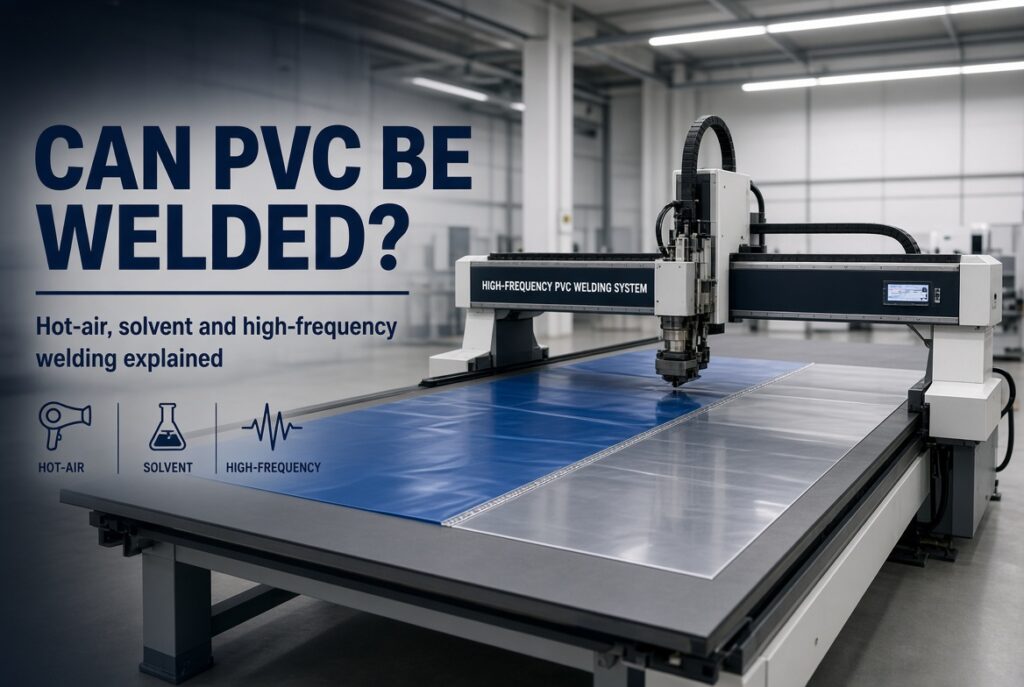
PVC is a widely used plastic material found in everything from pipes and fittings to sheets, covers and flexible manufactured products. If you need to join two pieces of PVC together, you may be wondering whether welding is a suitable option. Well, the answer is yes. PVC can be welded using several different techniques, although the most appropriate method will depend on the type of PVC, the application and the type of joint you need to create. So, can PVC be welded, and which welding method should you use?
What is PVC welding?
PVC welding is a process used to join compatible PVC materials by creating a bond between the surfaces. Unlike joining methods that rely on a separate adhesive, welding uses heat or electromagnetic energy to soften the PVC. Pressure can then be applied to bring the materials together and form a permanent joint. There are actually several ways to weld or join PVC, though the most suitable option will depend on the material and the finished product. The main methods include:
- Hot-air welding
- Solvent welding
- Adhesive bonding
- High-frequency welding
While these processes all join PVC, they work in different ways and are suited to different applications.
Here at TTF Ltd, we specialise in high frequency, ultrasonic and heat welding equipment for sealing flexible plastics.
So what are the different ways to weld PVC?
Before choosing a welding method, you should consider the type of PVC you are working with and the requirements of the finished product.
Hot-air welding
Hot-air welding uses heated air to soften the PVC at the point where the joint needs to be formed. A compatible PVC welding rod can then be introduced into the joint, allowing the softened materials to fuse together. Once the area cools, a solid welded connection is created.
This technique can be useful for PVC sheets, pipes, tanks and fabricated components. It can also be suitable when working with larger or more complex PVC structures.
The process requires control over factors such as temperature, welding speed and pressure. Too little heat can result in a weak joint, while excessive heat can damage the PVC.
A useful general overview of plastic welding methods is available from TWI.
Solvent welding
Solvent welding is another method used to join certain PVC components, particularly pipes and fittings. A suitable solvent cement softens the surfaces of the PVC. When the components are brought together, the softened surfaces bond and form a strong connection as the joint sets.
This method is commonly associated with PVC pipework, where a simple and reliable connection is required. However, solvent welding is different from thermal welding methods such as hot-air or HF welding, as it relies on a solvent rather than heat to create the bond.
Adhesive bonding
PVC can also be joined using suitable adhesives. Adhesive bonding can be useful where welding equipment is not practical or where the design of the product makes another joining method more appropriate.
However, if you require a continuous, airtight or watertight seam, welding is likely to be the better option.
What is high-frequency PVC welding?
High-frequency welding is a specialist process that uses electromagnetic energy to generate heat within compatible PVC materials. Rather than applying heat directly to the surface, the high-frequency field causes the molecules in the material to move and generate heat. This allows the PVC to soften at the point where the weld needs to be created.
The materials are then pressed together under controlled pressure. As the welded area cools, the materials form a strong and permanent seam. This makes HF welding particularly useful for flexible PVC and is commonly used for manufacturing PVC products where consistent and repeatable seams are required. It can also be used to create shaped, curved or angled welds, making it suitable for products with more complex designs.
You can read more about the process in this explainer of high frequency welding and Wikipedia’s radio-frequency welding page.
What are the benefits of HF welding PVC?
One of the main benefits of high-frequency welding is the ability to produce strong and consistent seams. When the correct material, tooling and welding parameters are used, HF welding can provide:
- Strong and durable joints
- Airtight seams
- Watertight seams
- Clean and precise weld lines
- Repeatable production
- Fast production cycles
- Reduced reliance on adhesives
This can make HF welding particularly attractive for commercial and industrial manufacturing. Because the process can be controlled using specialist machinery, the same weld pattern can be reproduced across large numbers of products.
Can you create angled PVC welds?
Yes. One of the advantages of high-frequency welding is that the tooling can be designed to create different shapes and weld patterns. This means you are not necessarily restricted to straight PVC seams. Depending on the design and equipment, HF welding can be used to create angled, curved and shaped welds.
For example, a PVC product may require a seam to follow a corner or a particular geometric profile. The welding tool can be manufactured to match the required shape.
The design of the tooling is therefore an important consideration when producing complex PVC products. You also need to ensure that the material can be positioned correctly and that consistent pressure can be applied across the entire weld area. TTF can help with custom tooling, parts and consumables.
What products can be made using HF-welded PVC?
High-frequency welding is particularly useful for products manufactured from flexible PVC where sealed seams are required. Depending on the application, this can include:
- Inflatable products
- PVC covers
- Flexible tanks
- Protective covers
- PVC bags and containers
- Industrial curtains
- Flexible ducts
- Tarpaulins
- Technical textile products
The ability to create airtight and watertight seams makes HF welding particularly useful for products that need to contain air or liquids. You can find out more about the industries we work with.
Does PVC thickness affect welding?
Yes. The thickness and construction of the PVC can affect the welding process.
Different materials and thicknesses can require different levels of energy, welding times and pressure. The formulation of the PVC can also influence how it responds to the welding process.
For HF welding in particular, you should establish that the specific PVC formulation is suitable before beginning production.
Testing the material and proposed weld configuration can help you determine the appropriate settings and identify any potential problems before manufacturing begins. Our engineering service team can support machine set-up, training and technical assistance.
What equipment is needed for HF welding?
High-frequency welding requires specialist equipment designed to generate and control electromagnetic energy.
A typical HF welding system will include a high-frequency generator, a welding press and specially designed tooling or electrodes.
The tooling determines the shape and position of the weld, making it particularly important when manufacturing products with complex or angled seams.
For larger production runs, automated or semi-automated equipment can also be used to improve consistency and production efficiency.
So, can PVC be welded?
Yes, PVC can be welded, but there are several different methods available and the right option will depend on your particular application.
Hot-air welding can be used to join PVC components using controlled heat and, where required, a compatible welding rod. Solvent welding and adhesive bonding can also be suitable for certain applications, particularly PVC pipework and other components.
For flexible PVC products where you need strong, consistent and sealed seams, high-frequency welding can offer significant advantages. The process uses electromagnetic energy to heat the material before pressure is applied to create the weld, and specialist tooling can be designed to produce straight, angled, curved or otherwise shaped seams.
Here at TTF, we are leading specialists in high frequency, ultrasonic and heat welding equipment for sealing flexible plastics. So for more information or advice, why not get in touch today?