
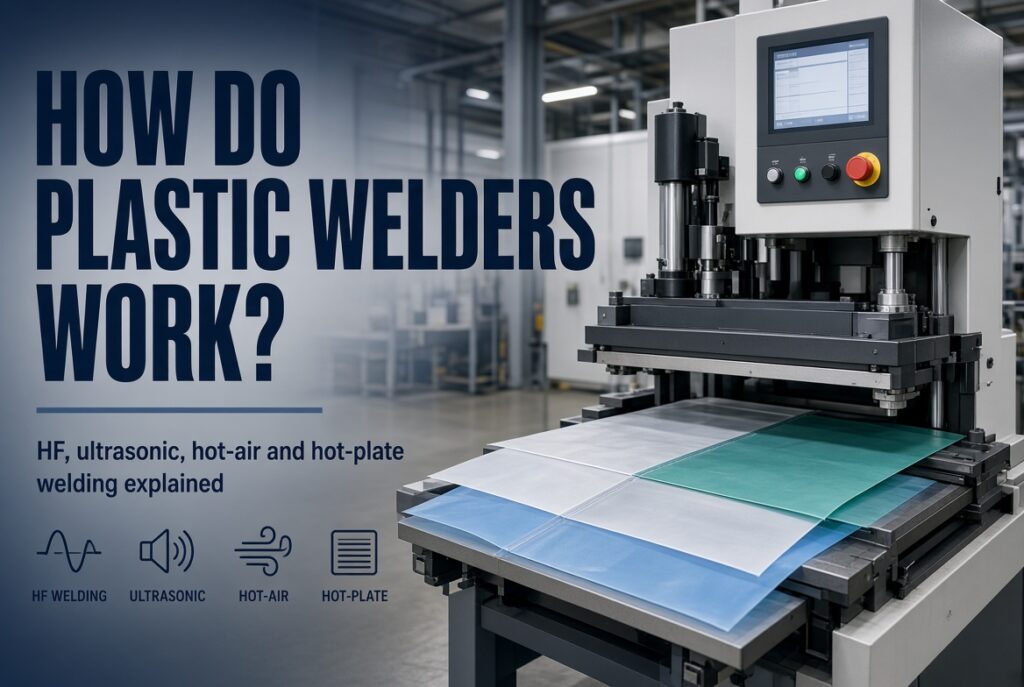
Plastic welding is a useful way of joining compatible thermoplastic materials without relying on traditional fasteners or, in some applications, adhesives. From pipes and sheets to flexible PVC products and industrial components, plastic welding can create strong and permanent joints when the correct process is used. But there are several different types of plastic welding, and the way a plastic welder works will depend on the material and the equipment being used. So, how do plastic welders work, and what are the different options available?
What is a plastic welder?
A plastic welder is a piece of equipment used to join compatible thermoplastic materials by softening or melting the material at the point where the joint needs to be created. Once the plastic has been heated sufficiently, the surfaces can be brought together under pressure. As the material cools, it forms a solid connection.
However, the exact process depends on the type of plastic welder being used. Some machines apply heat directly to the plastic, while others generate heat within the material itself using methods such as high-frequency or ultrasonic energy.
Here at TTF Ltd, we specialise in high frequency, ultrasonic and heat welding equipment for sealing flexible plastics.
How does plastic welding work?
Although different welding processes use different techniques, the basic principle is similar. The plastic is heated until it reaches a suitable state for joining. The softened material is then brought together, often under controlled pressure, before being allowed to cool and solidify. The process will generally involve:
- Preparing the plastic surfaces
- Positioning the materials correctly
- Applying heat or energy to the welding area
- Bringing the softened materials together
- Applying pressure where required
- Allowing the joint to cool
- Inspecting the finished weld
The temperature, welding time, pressure and energy required will depend on the material and the type of welding process being used.
A useful overview of plastic welding methods is available from TWI.
What are the different types of plastic welding?
There are several ways of welding plastic, and no single method is suitable for every application. The most common options include:
- Hot-air welding
- Ultrasonic welding
- Hot-plate welding
- High-frequency welding
The best method will depend on the type of thermoplastic, the thickness of the material, the shape of the product and the requirements of the finished joint. You can also find out more about the industries we work with.
How does hot-air plastic welding work?
Hot-air welding uses a stream of heated air to soften the plastic surfaces that need to be joined. A compatible plastic welding rod can then be introduced into the joint. As both the material and welding rod soften, they can be fused together. Once the joint cools, a permanent weld is formed.
Hot-air welding is often useful for sheets, pipes, tanks and fabricated plastic components. It can also be carried out using handheld equipment, making it suitable for certain repair and fabrication applications.
How does ultrasonic plastic welding work?
Ultrasonic welding uses high-frequency mechanical vibrations to generate heat at the point where two plastic components meet. The components are held together while the ultrasonic equipment applies vibrations to the joint. Friction and molecular movement generate heat, causing the plastic at the interface to soften. Pressure is then maintained while the material cools, creating the finished joint.
Ultrasonic welding can be particularly useful for smaller plastic components and high-volume manufacturing where fast, repeatable welds are required. It is commonly used where components need to be joined accurately without adding adhesives or other joining materials.
You can read more about the process in this overview of ultrasonic welding.
How does hot-plate welding work?
Hot-plate welding uses a heated plate to soften the surfaces of two plastic components. The components are pressed against the heated plate until the surfaces reach a suitable temperature. The plate is then removed and the softened surfaces are brought together under pressure.
Once the material cools, the two components form a permanent joint.
This method can be useful for larger plastic components where a flat or controlled joining surface is available.
How does high-frequency plastic welding work?
High-frequency welding, also known as HF or radio-frequency welding, works differently from conventional hot-air welding. Instead of applying heat directly to the surface of the plastic, high-frequency electromagnetic energy is used to generate heat within compatible materials.
The PVC or other suitable thermoplastic is positioned between specialised electrodes or tooling. When the high-frequency energy is applied, the molecules within the material respond to the electromagnetic field and generate heat. The material softens at the intended weld area, allowing pressure to be applied. Once the energy is switched off, the material cools under pressure and forms a permanent seam.
This makes HF welding particularly useful for manufacturing products where you need consistent and repeatable welds. A practical explainer of the process is available from Carmo.
Why is HF welding useful for PVC?
PVC is one of the materials that can be particularly well suited to high-frequency welding. The process can be used to create strong, sealed seams in suitable flexible PVC products. This can be important when manufacturing products that need to be airtight or watertight.
HF welding can also produce clean and precise weld patterns, making it suitable for products where the appearance and consistency of the seam are important.
Depending on the tooling, the process can be used to create:
- Straight seams
- Angled seams
- Curved seams
- Shaped welds
- Continuous sealed joints
The ability to create complex weld profiles is one reason HF welding can be particularly useful for specialist PVC manufacturing.
What does the tooling do in HF welding?
Tooling is an important part of the high-frequency welding process. The tooling or electrodes are designed to apply the energy and pressure to the specific area where the weld needs to be created. This means the tooling can be manufactured around the shape of the product.
For example, if you need to manufacture a PVC product with an angled or curved seam, the welding tool can be designed to follow that profile.
The quality of the tooling can therefore have a significant effect on the consistency and appearance of the finished weld. TTF can help with custom tooling, parts and consumables.
Does every plastic weld?
No. Not every plastic can be welded using the same processes. Plastic welding is generally associated with thermoplastics because these materials can be softened by heat and then solidified again as they cool.
However, different thermoplastics respond differently to heat and energy, so a welding process that works well for one material may not be suitable for another. As such, before selecting a plastic welding process, you should consider:
- The type of plastic
- The material formulation
- The thickness
- The shape of the components
- The required joint strength
- Whether the joint needs to be airtight or watertight
- The production volume
What affects the quality of a plastic weld?
Several factors can influence the quality and strength of the finished weld.
Material preparation is important because dirt, moisture or contamination can interfere with the joining process.
Temperature or energy levels also need to be controlled carefully. If the material is not softened sufficiently, the joint may be weak. Excessive heat or energy can cause degradation or unwanted deformation.
Pressure and welding time can also affect the finished result.
For HF welding in particular, the correct combination of power, time, pressure and tooling is important for producing consistent seams.
Testing the proposed welding process before full production can help establish the appropriate settings for the material and product. Our engineering service team can support machine set-up, training and technical assistance.
Are plastic welders suitable for industrial production?
Yes. Many plastic welding processes are particularly well suited to industrial and commercial manufacturing.
One of the main advantages of specialist welding equipment is repeatability. Once the appropriate settings and tooling have been established, the same welding process can be repeated across large numbers of products.
HF welding can be especially useful for this type of production because the tooling can be designed around a specific product and weld pattern.
This can allow manufacturers to produce consistent seams across multiple components while maintaining control over the welding process.
So, how do plastic welders work?
Plastic welders work by creating heat or energy at the point where compatible thermoplastic materials need to be joined. The softened material is then brought together, usually under pressure, before cooling to form a permanent joint.
There are several different ways to achieve this. Hot-air welding applies heat directly to the plastic, ultrasonic welding uses high-frequency vibrations, and hot-plate welding uses a heated surface to soften compatible materials.
High-frequency welding works differently again, using electromagnetic energy to generate heat within suitable plastics such as PVC. This makes it particularly useful for producing strong, precise and repeatable seams, including angled, curved and complex weld patterns.
Here at TTF, we are leading specialists in high frequency, ultrasonic and heat welding equipment for sealing flexible plastics. So for more information or advice, why not get in touch today?